The Service Most Lincoln Lawns Need Most
A lawn that water runs off rather than soaks into during heavy rain
Thin, patchy turf despite regular fertilization
Brown or dormant patches that don't recover even with watering
Visible compaction (hard ground, footprints that stay, equipment ruts that don't fade)
Thatch buildup more than 1/2 inch thick on the surface
A lawn that doesn't respond to fertilization the way it should
A property where the lawn has been neglected for years and needs a structural reset
A new construction property where builder compaction is a known issue
Aeration is one of the few services where the result is dramatic enough that most homeowners are surprised at how different their lawn looks within a season of consistent annual treatment.
What's On This Page
Why Clay Soil Needs Aeration
How Core Aeration Works (and Why Spike Aeration Doesn't)
The Right Time to Aerate in Lincoln
Our Process
FAQs
Why Clay Soil Needs Aeration
The Compaction Problem
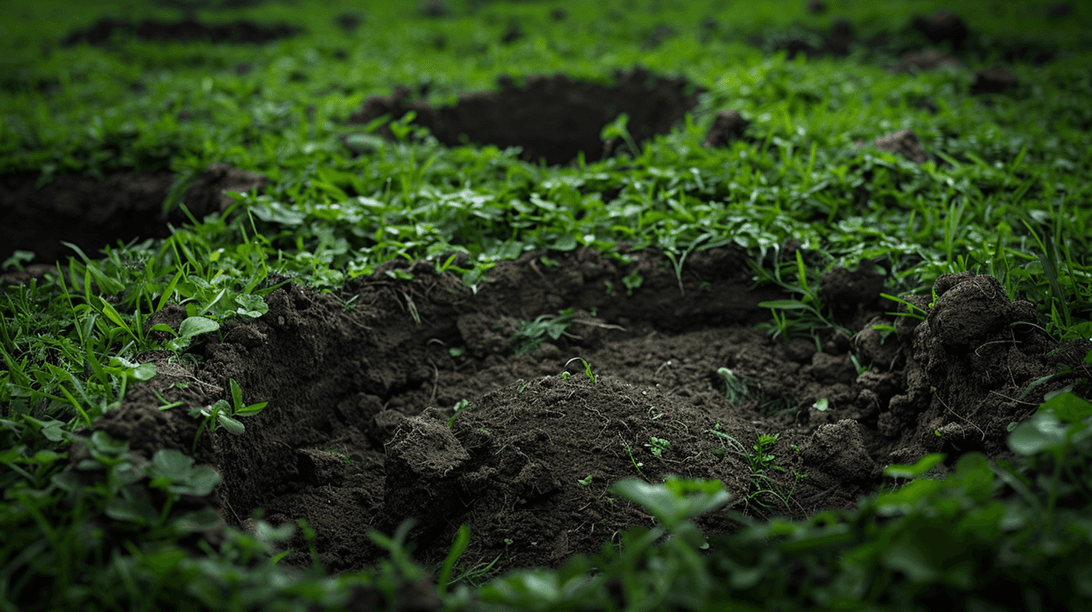
Lincoln sits on the eastern edge of the Great Plains, where the soil is predominantly heavy clay (silty clay loam, technically). Clay particles are tiny and pack tightly. When you compact clay, the spaces between particles close up, and once they close, they stay closed.
What compaction actually does to a lawn:
Blocks oxygen. Grass roots need oxygen exchange with the soil. Compacted soil has dramatically reduced pore space, and root activity slows. Roots stay shallow and weak.
Prevents water penetration. Water can't soak into compacted soil. Instead, it runs off across the surface. The water that does penetrate stays in the top inch or two, encouraging shallow rooting.
Blocks nutrient penetration. Fertilizer applied to compacted soil stays at the surface. Roots can't reach the nutrients in the root zone where they're needed.
Discourages deep rooting. Healthy grass develops 6 to 12 inches of root system. Compacted soil prevents this entirely. The grass roots stay in the top 2 to 3 inches, which makes the lawn extremely drought-vulnerable.
Creates thatch buildup. Without microbial activity in the soil, dead organic matter doesn't break down. Thatch builds up at the surface. When thatch exceeds 1/2 inch, it acts as a barrier that further blocks water, oxygen, and nutrients.
Why compaction is unavoidable:
Every lawn becomes compacted over time. Foot traffic, mower weight, kids playing, pets running, natural settling, and the simple physics of clay particles all contribute. Even a perfectly cared-for lawn becomes meaningfully compacted within 2 to 3 years of installation.
The only solution is physical decompaction. No fertilizer, watering technique, or amendment will solve compaction. The soil has to be physically opened up, which is what core aeration does.
How Core Aeration Works (and Why Spike Aeration Doesn't)
Real Aeration Versus the Fake Kind
Two completely different processes get called "aeration" in the consumer market. They have dramatically different effects on the lawn.
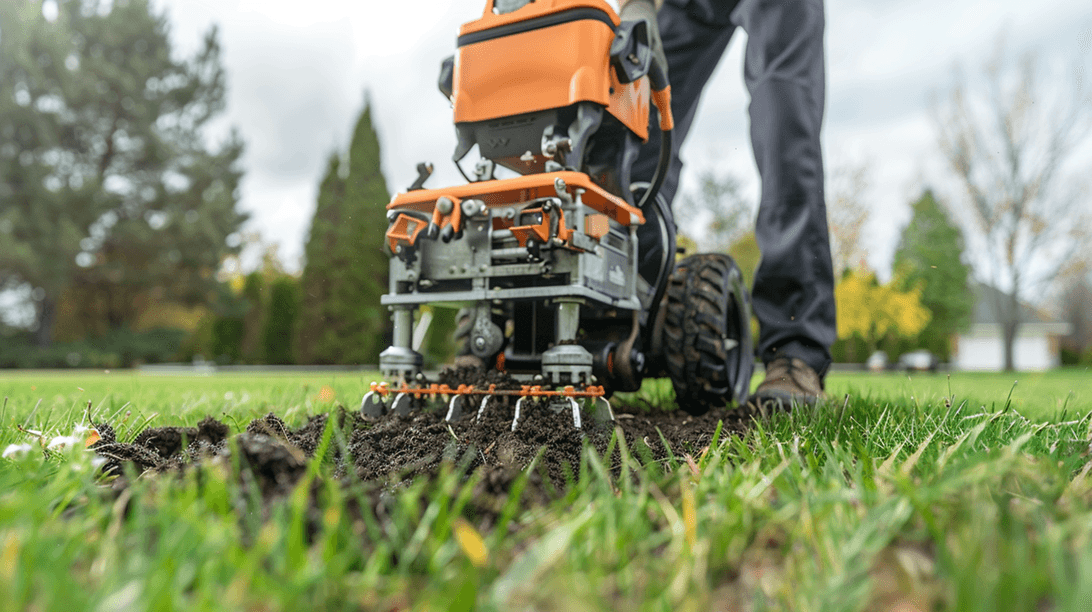
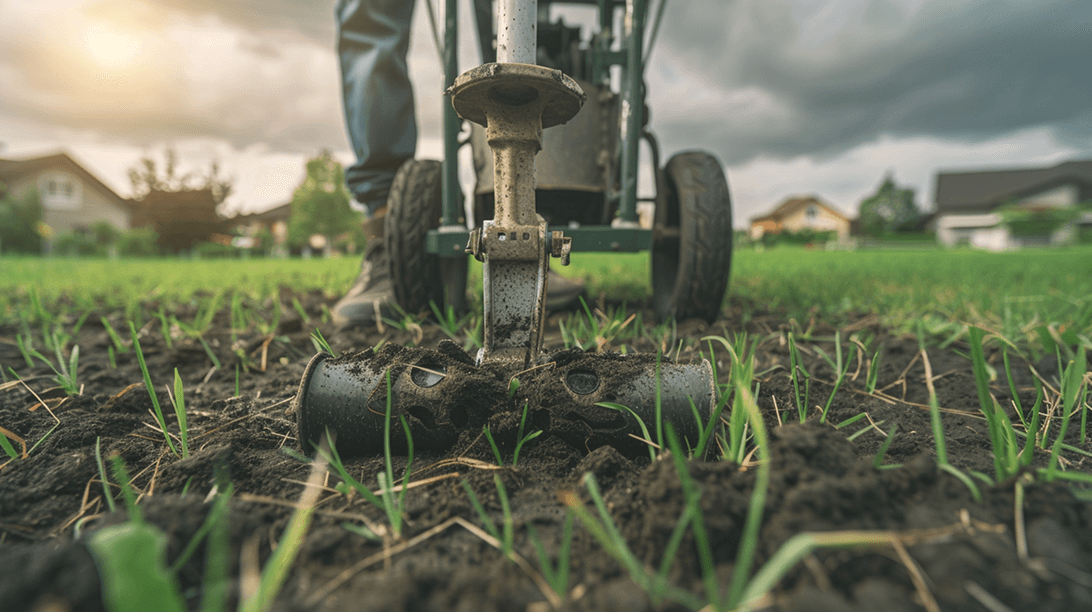
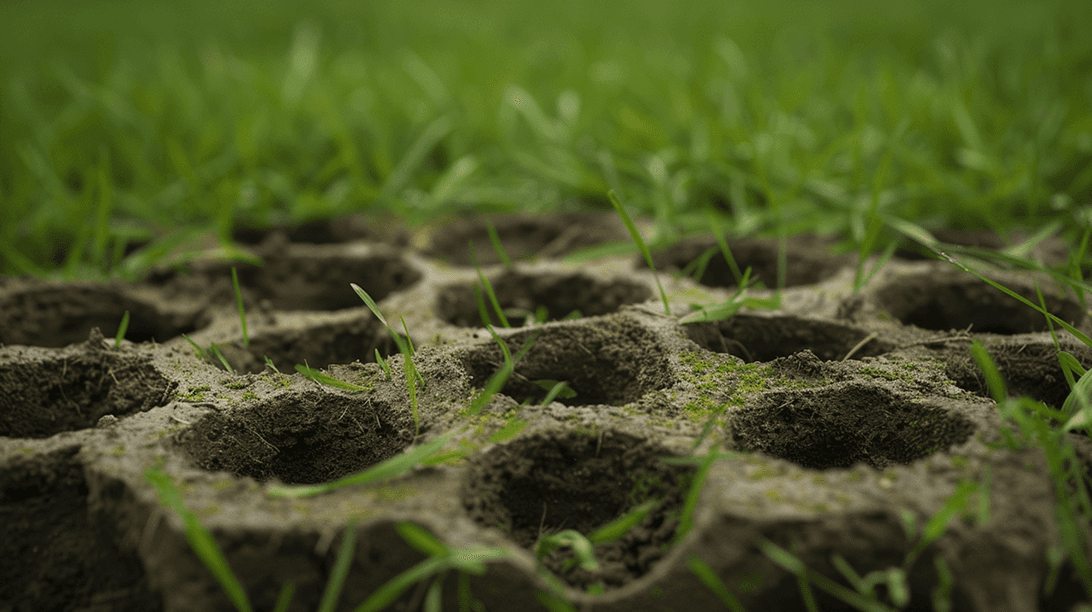
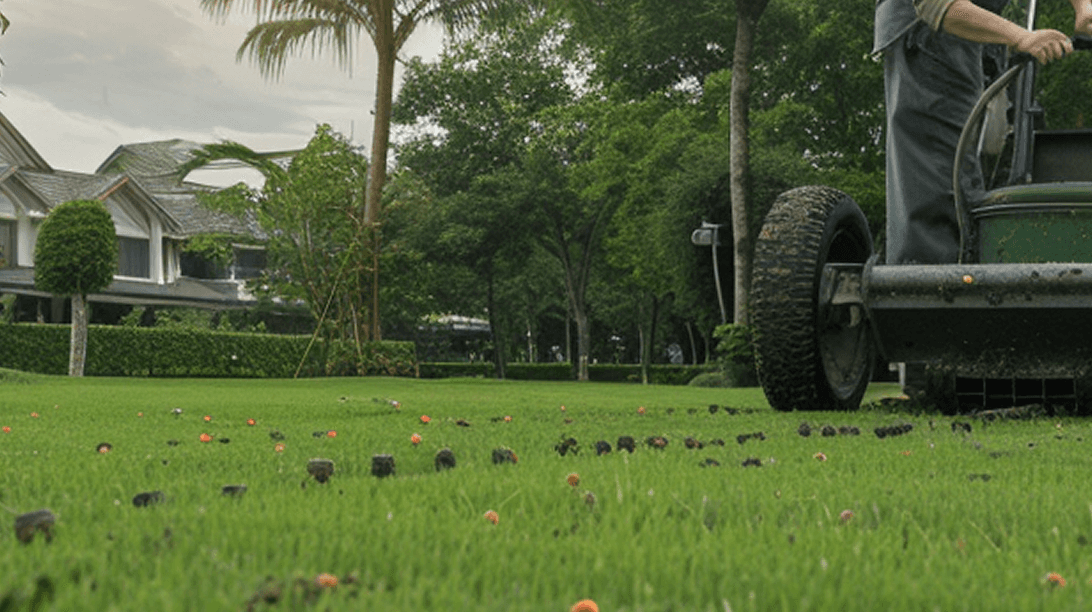
Core aeration (also called plug aeration). A mechanical machine uses hollow metal tines to remove actual plugs (cores) of soil from the lawn. Each core is typically 3/4 inch in diameter, 2 to 3 inches deep, and roughly the size of a finger. The machine pulls thousands of these cores across the lawn surface. Each core creates a permanent hole that allows oxygen, water, and nutrients to penetrate to the root zone. The plugs are left on the surface to break down over the next few weeks.
This is what works. Real core aeration physically decompacts the soil and creates the openings the lawn needs to recover.
Spike aeration. A machine (or worse, attachments for shoes) pushes solid spikes into the lawn. The spikes don't remove any soil. They just punch holes that close within hours. In compacted clay, spike aeration actually makes compaction slightly worse because the soil around the spike gets pressed even tighter.
This doesn't work. Spike aeration is essentially theater. It looks like aeration. It produces no meaningful improvement.
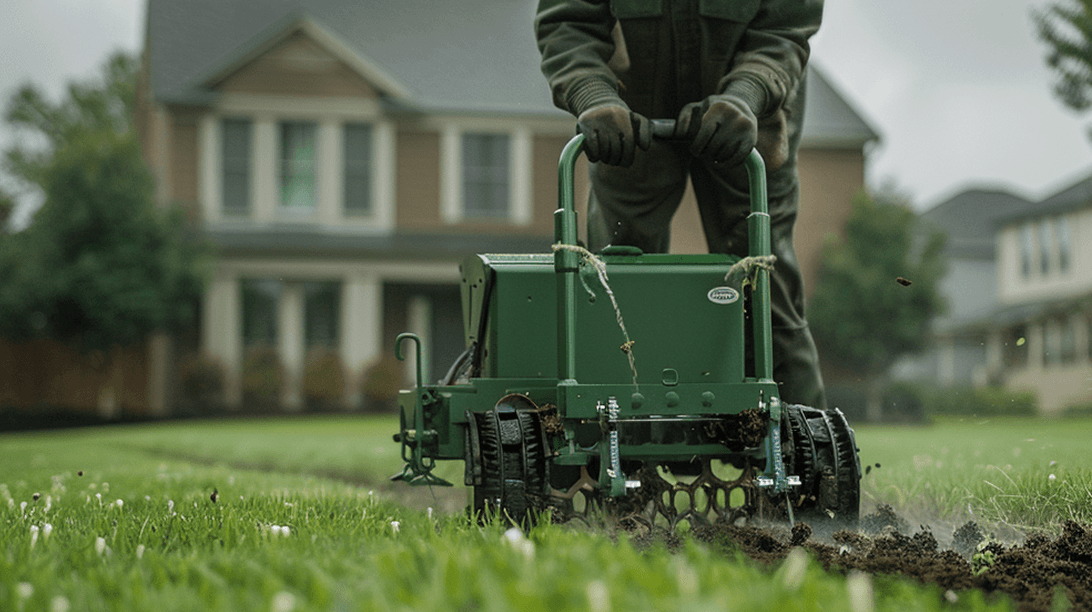
Our equipment. Walk-behind or ride-on core aerators with adjustable tine depth. For typical residential properties, we set the machine to pull 3-inch-deep cores at 2 to 3 inch spacing. A standard residential pass removes 30 to 50 plugs per square foot.
The visible result:
Immediately after aeration, the lawn looks like a goose got loose on it. Thousands of small dirt plugs cover the surface. Within 2 to 3 weeks, the plugs break down (or get pulverized by mowing) and disappear. The holes themselves remain, and the lawn responds dramatically over the following 6 to 8 weeks with thicker growth, better color, and deeper rooting.
Aeration paired with overseeding. Fall aeration is the perfect time to overseed. Seed dropped directly into aeration holes has guaranteed soil contact (critical for germination) and is protected from wind, birds, and surface drying. Most overseeding work happens immediately after aeration for this reason.
The Right Time to Aerate in Lincoln
Timing Matters as Much as Technique
For cool-season lawns (tall fescue, Kentucky bluegrass blends, the typical Lincoln lawn), the timing for aeration is well-established.
Best time: Early fall (mid-September to mid-October). Soil temperatures have cooled but the grass is still actively growing. Roots are entering their primary growth phase. Recovery is fast and the lawn responds dramatically over the following 6 weeks. This is also the ideal time for overseeding, which pairs perfectly with aeration.
Acceptable time: Early spring (mid-April to early May). When soil temperatures have warmed but heat stress hasn't started. Less ideal than fall because spring is the lawn's secondary growth period rather than primary, but useful for properties that missed the fall window or have severe enough compaction to benefit from twice-yearly aeration.
Wrong time: Summer. Aerating during heat stress damages the lawn. The exposed soil dries quickly and the open root zones lose more moisture than they can replace. We never aerate June through August on cool-season lawns.
Wrong time: Winter. Frozen ground can't be aerated. The cores either don't form or come out as ice plugs. No benefit.
Annual aeration is standard for compacted Lincoln properties. Most properties benefit from one fall aeration per year. Severely compacted properties (heavy clay, high foot traffic, athletic use, new construction with builder compaction) benefit from twice-yearly aeration (spring and fall) for the first 2 to 3 years before dropping to annual maintenance.
Our Process
How a Moku Aeration Visit Runs
Step 1: Walk the property and assess. Initial visit to evaluate compaction level, identify any obstacles (irrigation heads, low-voltage lights, septic components, shallow utilities), and confirm timing for the season.
Step 2: Schedule the visit. Aeration timing is driven by weather and soil conditions, not rigid calendar dates. We confirm 2 to 3 days before the visit.
Step 3: Mark obstacles. Before the machine starts, we mark every visible obstacle to avoid (sprinkler heads, low-voltage wires, anything below the surface that could be damaged).
Step 4: Aerate the property. Multiple passes in different directions for thorough coverage. The full lawn gets covered including beds-adjacent areas where compaction is often worst.
Step 5: Add-ons if scheduled. Overseeding follows immediately if it's part of the scope. Fertilization or starter food can be applied at the same time. Bed work or other services pair naturally with the aeration visit.
Step 6: Cleanup and instructions. Tools and equipment cleared. The homeowner gets watering instructions (heavier watering for the first 2 weeks helps the lawn recover and supports any overseeding). Plugs are left on the surface to break down.